
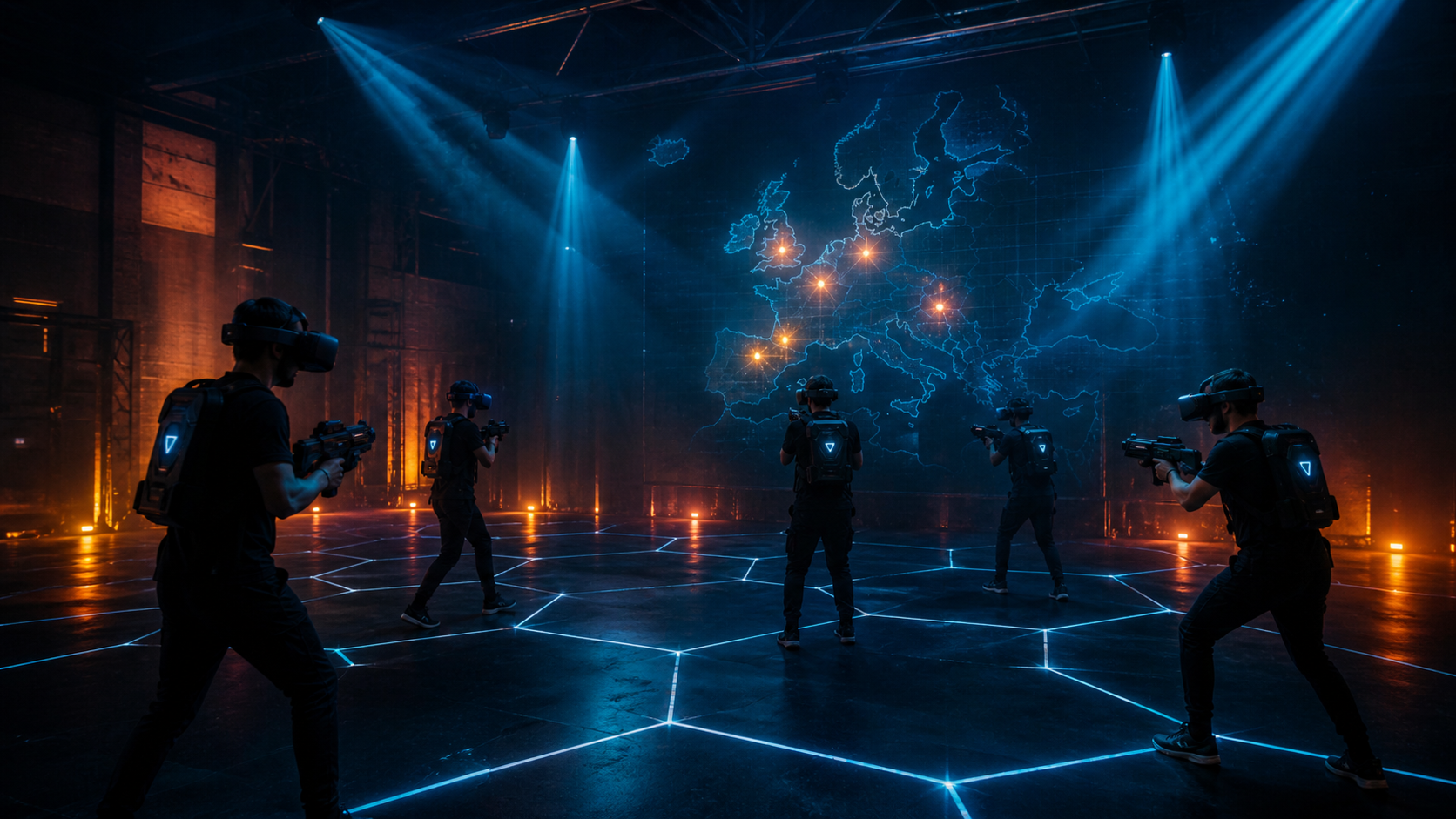
Paris-based Esports Virtual Arenas (EVA) has raised over €35 million in a growth round led by French mid-market investor RAISE Invest, the company confirmed on April 29, 2026. The capital is earmarked for an aggressive arena rollout — primarily in Germany and Spain — and for scaling EVA Karting GP, the operator’s newest free-roam format.
Stripped of the press-release gloss, this is the first time a free-roam VR operator has been funded at a scale that suggests “European chain” rather than “novelty venue.” That’s the headline. The interesting part is what’s underneath it.
The deal
| Item | Detail |
|---|---|
| Amount | €35M+ (≈ $39.6M) |
| Lead | RAISE Invest (Paris) |
| Use of funds | Arena expansion (DE, ES), EVA Karting GP rollout, new family titles |
| Existing footprint | 70+ arenas across 10 countries (48 in France) |
| Target by EOY 2026 | 100+ arenas |
RAISE Invest describes itself as an “active minority shareholder” focused on profitable, fast-growing French mid-market companies. Partner Vincent Sauzay is leading the deal on RAISE’s side. There is no debt component disclosed.
What “expansion” actually means
EVA already operates in Cologne and Unna in Germany, and in Madrid and Málaga in Spain. The new round adds named cities Krefeld, Granada, and Barcelona, plus roughly ten net-new openings across the two countries.
Two things to flag for anyone tracking this market:
- The model is franchising, not flagship retail. EVA licenses the arena format to third-party operators — that’s how a 2018-founded company hits 70+ sites without burning capital on real estate. The €35M doesn’t go into rent; it goes into product, tooling, and franchisee enablement. Going from 70 to 100+ arenas in roughly eight months is a steep curve, but it’s a sales-pipeline curve, not a construction one.
- Germany is the strategic prize. Spain is incremental. Germany is where EVA’s free-roam shooter ships against established LBE (location-based entertainment) competition — Sandbox VR partners, Holodeck-style operators, escape-room chains pivoting to VR. Krefeld signals a Rhine-Ruhr cluster strategy on top of the existing Cologne/Unna footprint.
The catalogue funding this round
EVA’s product surface is broader than most coverage suggests:
- EVA Battle Arena — the flagship 5v5 free-roam VR shooter. EVA reports “10,000+ regular players in France” alone. This is the format the EVA Pro League is built on.
- EVA Karting GP — real electric drift karts inside 500 m² arenas, overlaid with a VR racing world. Debuted at Paris Games Week 2025; full franchise rollout is targeted for end of 2026.
- Two unannounced family-oriented titles slated for 2026.
The Karting GP angle matters strategically: it lets a single physical site monetize two very different audiences (competitive shooter players vs. casual social groups) on the same hardware-software stack, which is exactly the kind of utilization story franchise investors underwrite.
Where the EVA Pro League fits
The Pro League launched on April 14, 2026 with eight European esports orgs — G2, OG, Solary, Vitality, Heretics, GiantX, SK Gaming, Shifters — running a BO3 free-roam format. It is the single thing that distinguishes EVA from every other LBE VR operator on the market.
Sandbox VR sells narrative experiences. Zero Latency sells team-shooter sessions. Neither runs a structured pro circuit with branded national orgs and a season schedule. EVA does, and the €35M round is implicitly underwriting that thesis: that an LBE chain with a working pro league has higher long-term enterprise value than one without.
For our readers — players, teams, and viewers in the EVA ecosystem — that’s the practical takeaway. More arenas means a deeper amateur pipeline. A deeper amateur pipeline means stronger Bucharest League, Challenger League, and (eventually) Pro League rosters. Capital flowing in at the operator level eventually shows up as more events, more rounds, and more reasons for casual VR players to convert into competitive ones.
What we’d want to verify
A few things to keep an eye on as this story develops:
- Independent reporting. As of writing, the €35M figure traces back to a single corporate communication redistributed across German wires (Presseportal, Onvista, Startbase). Independent outlets — Sifted, Les Échos, TechCrunch — haven’t reported their own due diligence yet.
- The “1M+ players” figure. This is a cumulative lifetime number, not monthly active. It’s a useful directional metric, not a comparable one to MAU figures from other VR operators.
- Franchisee health. If EVA targets 30 net openings in eight months, the bottleneck won’t be capital — it’ll be qualified franchise operators with the floorspace, capex, and operational chops to run a 500 m² VR venue. Watch for partner announcements, not just opening dates.
Bottom line
Free-roam VR has spent the last decade as a curiosity. EVA’s bet — and now RAISE Invest’s bet — is that the next decade is when it becomes a chain. The Pro League is the proof point that EVA isn’t just selling tickets; it’s building an IP layer on top of arenas, the way bowling alleys sell leagues, not just lanes.
Whether the 100-arena target lands by December is less important than whether the franchise pipeline holds at 50, 70, 100, 150. €35M buys two to three years of runway to find out.
Sources: